Shush Little Baby

September 15th, 2008

Well, I suppose it was inevitable. I joked on the last episode of Core Intuition that I was being drawn in by the idea of developing software specifically for the “baby market.”

Since that time, I developed and deployed version 1.0 of the simplest product I’ve ever designed: Shush for the iPhone and iPod touch.

Check out Shush on the iTunes App Store.

Shush is an onomatopoeically titled iPhone application whose only purpose is to generate a constant shushing static noise, similar to the noise you might make when you want to quiet a baby who is frantic with fussiness and crying. Of course, you might also use it to calm your fussy and frantic self in a noisy airport, subway, or neighborhood where you live.

Partly due to time constraints, and partly due to purity of vision, Shush is an extremely simple 1.0 application. Its user interface consists of just a single button for starting and stopping the shushing, and a slider for fine-tuning the volume.
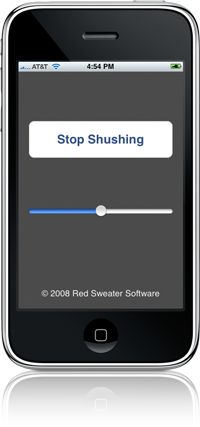
Although I really enjoy the minimal design of the app so far, I can see adding some features as time goes on. For instance, users have almost instantly asked for “pink noise” in addition or instead of the default white noise which is currently being generated. A common joke about pink noise is “you know, for girls,” but actually what pink noise refers to is a more appropriate distribution of the randomness in the noise, to suit the way that the human brain hears audio. Learn more about the colors of noise on Wikipedia.

Why White Noise?
Some of you without babies of your own may be wondering what white noise has to do with calming a baby. I read somewhere that every, or at least almost every, culture on earth has a word that is used for calming babies, and invariably it includes some form of this “shush” syllable, geared towards getting white noise out of soothing human’s mouth. In my reading of several books about baby care I have come across repeated advice to use shushing with a fussy baby, and it’s become especially emphasized by the very popular book: The Happiest Baby on the Block, by Dr. Harvey Karp.

One thing I can tell you is this product has already been extensively field tested. It’s easy enough to make a shushing noise with your mouth, but it gets tiring, and can be hard to sustain. I almost always have my iPhone with me, so it’s great to know that if a serious, full-blown fussy tantrum is taking place, I’ve got a little technological help in my pocket. How well the app will do among the general public is anybody’s guess, but I’m sure there will be at least a few jubilant parents out there who find this as useful as I do.

iPhone: $299.

Shush: $0.99

Stopping a fussy baby from screaming inconsolably? Priceless.

FastScripts As Apple Menu

September 15th, 2008

Jim DeVona was feeling homesick recently for the old Apple menu on Mac OS 9 and earlier operating systems. For those of you too young (or too old!) to remember, the Apple icon in the upper-left corner of our Mac desktops used to contain a highly customizable list of files and applications, for easy access from wherever you might be on your Mac.

As an avid user of FastScripts, Jim noticed something about the application that I frankly should make a bigger deal out of myself:

A little-advertised fact about FastScripts is that it will open anything in your Scripts folder, not just scripts.

In short, FastScripts makes a pretty good replacement for the old Apple menu, if that’s what you’re in to. And in general, if you find yourself wanting to access the same documents, applications, or even (gasp!) scripts on a regular basis, FastScripts does a stellar job of organizing them and making them instantly accessible from the menu bar.

You can even add keyboard shortcuts to documents or applications that you put in the FastScripts scripts folders. And don’t worry about copying the actual files in, just make an alias pointing to the original!

Thanks, Jim, for drawing attention to this under-appreciated feature of FastScripts.

Microsoft Ads Are Genius

September 12th, 2008

Lately we’ve been treated to the introduction of a couple new ads from Microsoft, featuring Jerry Seinfeld:

Windows Ads

The prevailing thoughts on the internet seem to be that these ads are ridiculous, that they make no salient point, that they are barely funny, and that they are a pathetic, misguided attempt by Microsoft to rekindle affection from a public that has grown quite accustomed to viewing the company as a stodgy old curmudgeon.

I think these ads are genius. Or if not genius, as close to genius as Microsoft could ever dream of coming. If I was one of Microsoft’s competitors, I might not be quivering in my boots quite yet, but I’d be thinking, “my god, I am wearing boots!”

Most critics of these ads point out, quite rightly, that the message doesn’t ask viewers to buy anything. If an ad doesn’t ask you to buy something, surely it’s a failure. I find this assessment flawed by default. Come on, people. Surely you, as sophisticated citizens of the internet, can appreciate that advertising is an art more than a science. If you want to criticize these ads, come up with something deeper than their failure to clearly condense into 30 seconds what purchasing action a consumer should take!

A more savvy viewer will notice that these ads are not meant to influence the immediate buying patterns of viewers, but instead to alter the long-term impression of the company that develops and markets the world’s leading desktop computer operating system. The company, Microsoft, is at once desperate to change your impression of it, but at the same time in no particular hurry to do so.

Imagine yourself in Microsoft’s position. you’ve got some 90% of the market share for computer operating systems, and you’re facing increasingly negative reports about the public’s impression of your place in the world. You’re a cold, hard company. You’re not very much fun. You don’t care about innovation. You’re a sleeper in a dancer’s universe. You’ve got no soul. You’re a plain old, boring, damn it all ridiculous stick in the mud. Microsoft, you suck.

If you’re Microsoft, and you’ve grown tired of these assessments, you wouldn’t have to be a rocket scientist to realize that owning 90% of the market and having a bajillion dollars … is a pretty good place to start from, in turning around your public image.

So begins the patient public image reform. When rumors started swirling about Microsoft enlisting Jerry Seinfeld to help sell its wares, the reaction was appropriately cynical. Come on, Microsoft. It’s going to take more to spin Windows than asking last decade’s comics to stand up for it.

But the ads that have actually come out, so far, are nothing like what anybody might have expected. They are so random, indeed so touchy-feely, that the universal reaction among the “smart-asses” I know, is to declare them ridiculous, not-funny, and utter failures.

These people are expecting something cliche from Microsoft, and instead the company has handed them a revolution. While Seinfeld’s collaboration with Microsoft has been widely heralded as a long-overdue reaction to Apple’s Mac/PC ads, Microsoft has instead taken a completely different path. And people can’t stand it.

I propose that Microsoft’s ads, with their mysterious yet evocative plot, are the most creative and purposeful ads ever to come out of the company. While devoted Apple fans might relish in declaring them an utter failure, I make the opposite assessment. These ads are the last best hope Microsoft has at erecting a dam in the face of a tidal shift towards Apple. Microsoft’s relative silence over the past few years has damaged the company. While Apple has charged the public’s mindset with compelling 30-second Mac/PC aphorisms, Microsoft sits idly by, taking the punches and sucking up the pain of each landed blow.

With these first ads from the Seinfeld era of Microsoft marketing, we see a company that is no longer simply spittling up blood, but instead spraying it in the face of its opponent. If Apple has been wondering when the competition will strike back, the answer is now. With a vengeance, albeit a somewhat mysterious one.

People ask what the point of Microsoft’s ad campaign is. What are they trying to convince us of? What do they want us to buy. Who are they trying to fool? If you have to ask, then you won’t be convinced. Microsoft already controls 90% of the market, and only a subset of the other 10% cares to call into question the motives or quality of these latest ads. The very fact that Microsoft can dance at all will be enough to sell them as belle of the ball to most who look on. So if you think the ads suck, don’t worry, you’re not the target audience. Laugh away!

Core Intuition 7: Promoting Ourselves Endlessly

September 5th, 2008

I’ve been pretty swamped these past few weeks helping to care for our newborn son, who arrived on August 8, 2008. That’s 08/08/08 for the numerophiles out there! We’re pretty excited by him, but we’re also experiencing the typical exhaustion that comes along with a new baby.

Finally got around to recording another episode of Core Intuition, which is now live and ready for download. In this episode we talk a bit about promotion and how small developers such as ourselves should approach it, and also rap about a few other issues such as how I’m being drawn toward the “baby oriented software” market.

Give it a listen, hope you enjoy!